
TUNI Compass
Transforming campus navigation from a mapping feature into a trust-centered, cross-device system.
✨ Overview
Role
Lead Product Designer
End-to-end product design (Lead UI Design, Lead UX Design, Research, Rapid Prototyping, User Flows, Logo Design)
Platform
iOS, Android, watchOS
Timeline
12 weeks
Deliverables
End-to-end navigation system strategy and experience design with extended design system with mobile and watch prototypes
Overview
TUNI Compass started as a request to build a campus navigation app.Through research and problem reframing, the project evolved from a simple mapping feature into a multi-surface navigation system designed to helping students navigate unfamiliar environments with confidence, reduce decision-point hesitation, increase first-attempt success, and create a scalable foundation for campus wayfinding.
✨ Highlights
✨The Challenge
Context
Original Brief
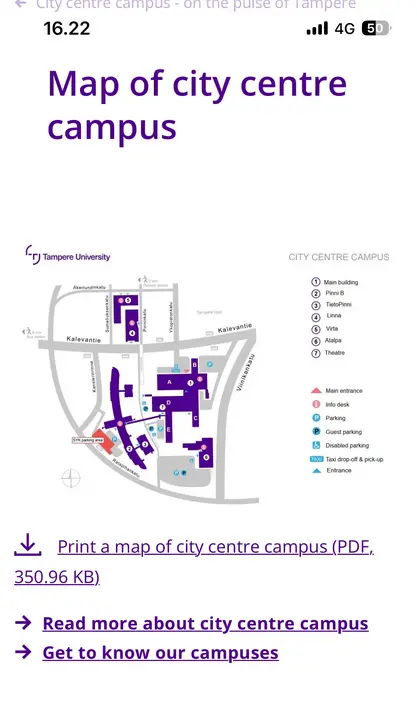
Tampere University operates across multiple campuses with complex building layouts, disconnected entrances, inconsistent naming conventions and Limited indoor GPS reliability.
Before TUNI Compass:
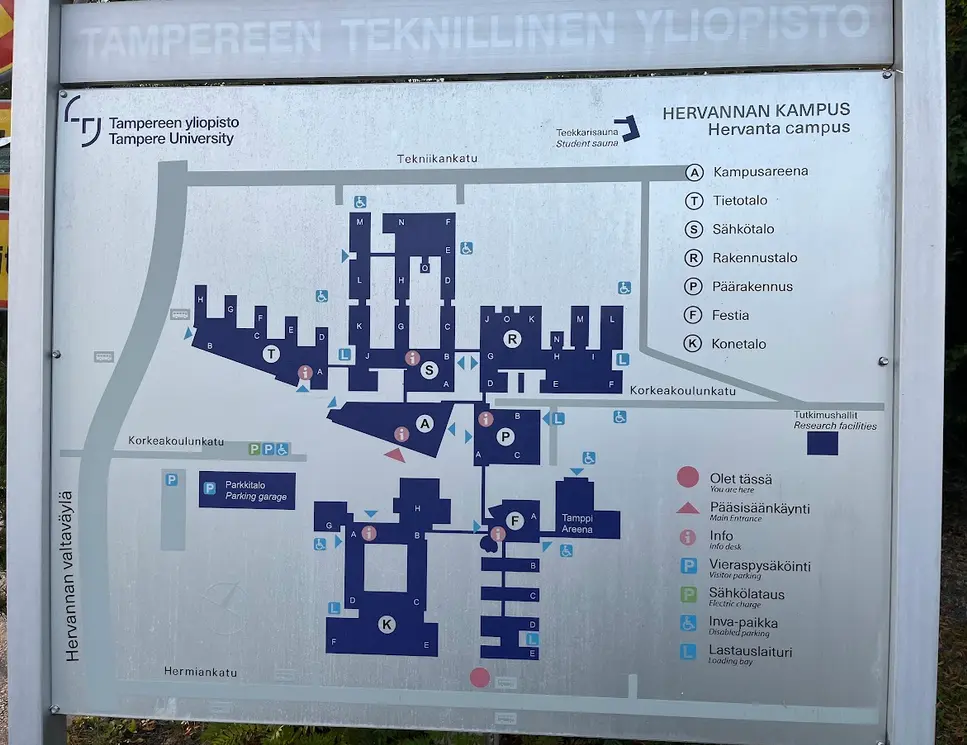
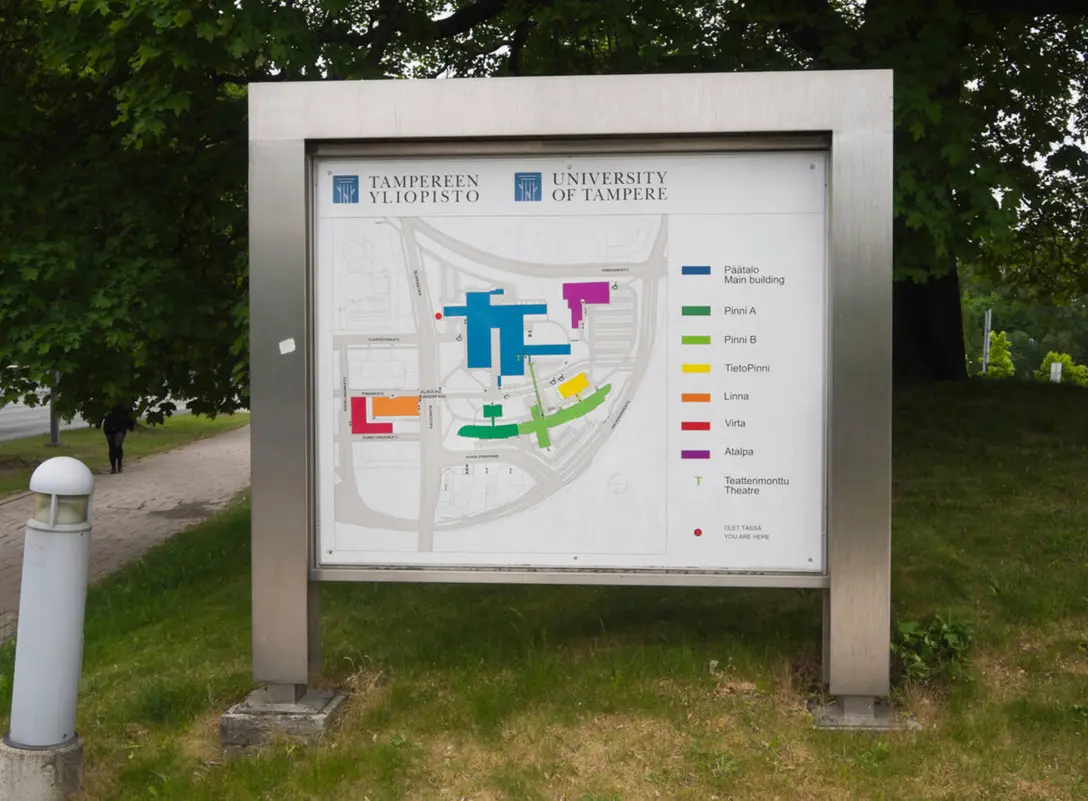
- Students relied on static PDF maps
- Google Maps did not accurately reflect internal pathways
- Support staff regularly answered repetitive navigation questions
- First-year and international students struggled disproportionately
The initial request was:
“Build a campus navigation app.”
ⓘ This request was feature-oriented and solution-constrained.
✨ Research & Key Insights
Before exploring solutions, I conducted exploratory research to understand where and why navigation failures occurred across Tampere University's campus environment.
The goal was not to validate a navigation app, but to uncover the underlying causes of navigation uncertainty.
Research Activities
To understand the problem from multiple perspectives, I combined qualitative observation with contextual inquiry:
- Interviews with first-year and international students
- Guerrilla usability testing across campus
- Observation of students navigating between lectures
- Analysis of common navigation-related questions during orientation periods
Through these activities, We identified recurring behavioral patterns that revealed navigation breakdowns were not caused by missing information, but by moments of uncertainty.
Key Insights
Navigation Friction Is Episodic, Not Continuous
These included:
- Building entrances with multiple doors
- Corridor intersections
- Elevator vs. stair junctions
- Floor transitions
- Areas where signage was present but ambiguous
At these points, observable behaviors included:
- Sudden stopping
- Looking back and forth between physical signage and phone
- Rotating in place to reorient
- Taking a few steps, then reversing direction
- Asking nearby peers
Importantly, these behaviors were consistent across different buildings.
Insight
Navigation breakdowns are not caused by distance - they occur at branching moments where directional commitment is required.
Design implication
Prioritize guidance at critical decision points rather than treating every part of the journey equally.
Certainty Outweighs Efficiency
When asked what they wanted, students frequently answered:
“The shortest route.”
However, observed behavior contradicted this preference.
Students consistently chose:
- Well-lit, main corridors over shortcuts
- Familiar paths over optimal ones
- Routes with visible landmarks
- Areas with higher pedestrian flow
Under time pressure, they defaulted to:
“I’ll take the way I know.”
This indicates a gap between stated preference and behavioral truth.
Insight
Users prioritize perceived certainty over theoretical efficiency.
System implication
Optimize for confidence and clarity rather than route efficiency alone.
Spatial Hierarchy Confusion Drives Cognitive Load
Students struggled less with locating room numbers and more with understanding spatial context.
Common breakdowns occurred during:
- Outdoor-to-indoor transitions
- Identifying the “correct” entrance among many
- Determining which floor wing corresponded to a classroom
- Interpreting inconsistent building naming conventions
In multiple cases, students said:
“I think I’m in the right building… but I’m not sure.”
The uncertainty was hierarchical – not directional.
Insight
Navigation friction increases when spatial hierarchy is unclear (Campus → Building → Floor → Block → Room).
System implication
The system must reinforce hierarchical orientation continuously, not just provide a destination marker.
Time Pressure Amplifies Ambiguity
When running late:
- Students scanned less
- Relied less on dense maps
- Abandoned signage faster
- Asked others for confirmation
- Increased walking speed, reducing environmental awareness
Under stress, tolerance for ambiguity dropped sharply.
Insight
Navigation systems must reduce ambiguity rapidly under high pressure conditions. Confidence must be established quickly.
System implication
Critical information must be immediately visible and decision focused not layered behind exploration.
ⓘ Key Takeaway: Students don't get lost because they lack maps. They get lost when uncertainty exceeds confidence. This insight reframed the challenge from building a navigation app to designing a system that helps students navigate unfamiliar environments with confidence.
Reframed Problem
Students struggle to confidently navigate unfamiliar campus environments because moments of uncertainty at key decision points cause hesitation, second-guessing, and unnecessary reliance on external assistance.
Design Challenge
"How might we help students navigate unfamiliar campus environments with confidence by reducing uncertainty at critical decision points?"
ⓘ This shifted the product from a mapping tool to a confidence system.
✨The Solution
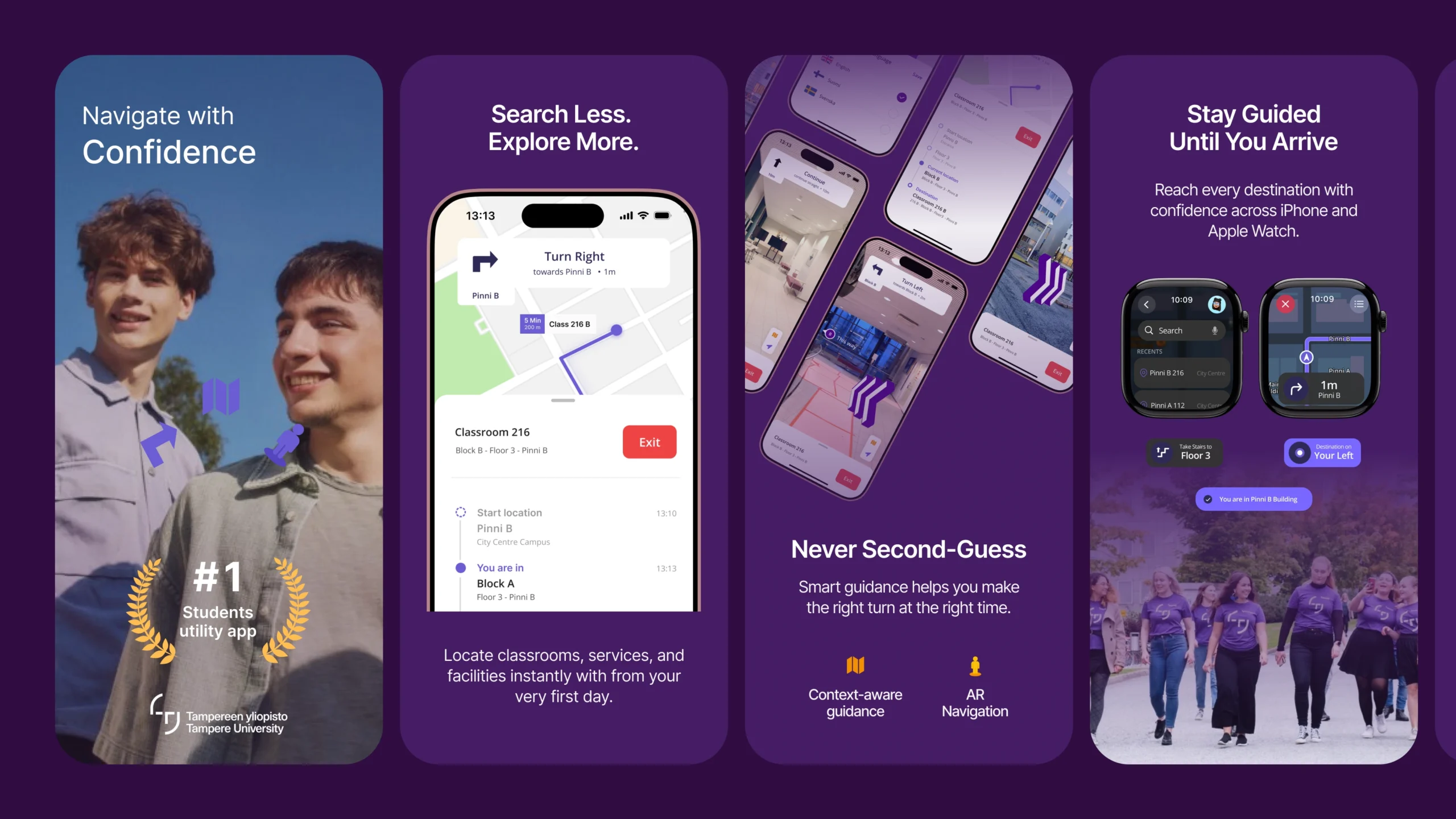
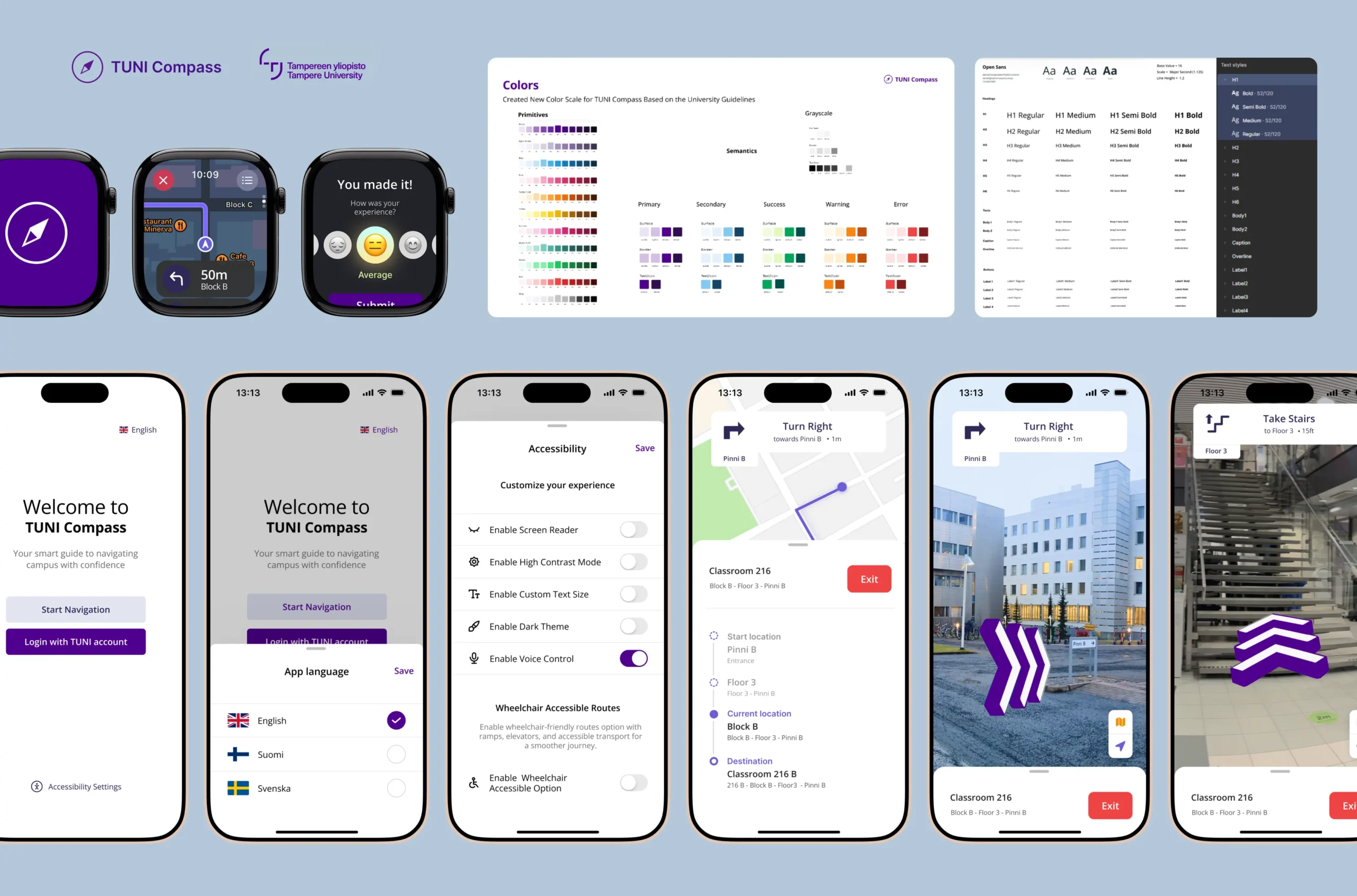
TUNI Compass is a multi-surface navigation platform designed to help students confidently navigate Tampere University's campuses.
The solution mainly focuses on reducing cognitive load, increasing navigation confidence, and improving first-attempt success when reaching destinations while providing a scalable foundation for future campus navigation needs.
Core capabilities include:
- Destination discovery and search
- Interactive 2D map guidance
- AR navigation assistance
- Location-aware recommendations
- Cross-campus scalability
- Cross-device navigation (mobile & watch)
Design Principles
- Trust over technical precision
The percentage of students who reached their destination without backtracking, asking for assistance, or taking a wrong turn.
- Measure behavior, not usage
Success is reduced hesitation and help-seeking - not taps, sessions, or screen time.
- Navigation Confidence
Post-task confidence ratings capturing how certain students felt while navigating unfamiliar locations.
- Reinforcement over instruction density
The time users spent pausing at entrances, intersections, and route transitions before confidently proceeding.
- Cross-surface consistency over feature replication
Behavior remains consistent across devices. Continuity builds trust more than feature parity.
Defining Success
Rather than measuring feature adoption, success was defined by a single outcome: helping students navigate unfamiliar campus environments with confidence reducing uncertainty.
To evaluate whether the solution reduced uncertainty during navigation, we focused on three key metrics:
- First-Attempt Navigation Success
The percentage of students who reached their destination without backtracking, asking for assistance, or taking a wrong turn.
- Decision-Point Hesitation
The time users spent pausing at entrances, intersections, and route transitions before confidently proceeding.
- Navigation Confidence
Post-task confidence ratings capturing how certain students felt while navigating unfamiliar locations.
✨ Designing for Confidence
Research revealed that students rarely became lost because they lacked directions. Instead, navigation breakdowns occurred when uncertainty exceeded confidence at key moments throughout the journey.
To address this, the solution was built around five experience innovations that transform navigation from a mapping tool into a confidence-centered wayfinding system.
Confidence-Centered Navigation
Traditional navigation systems focus on directing movement. TUNI Compass focuses on reinforcing confidence.
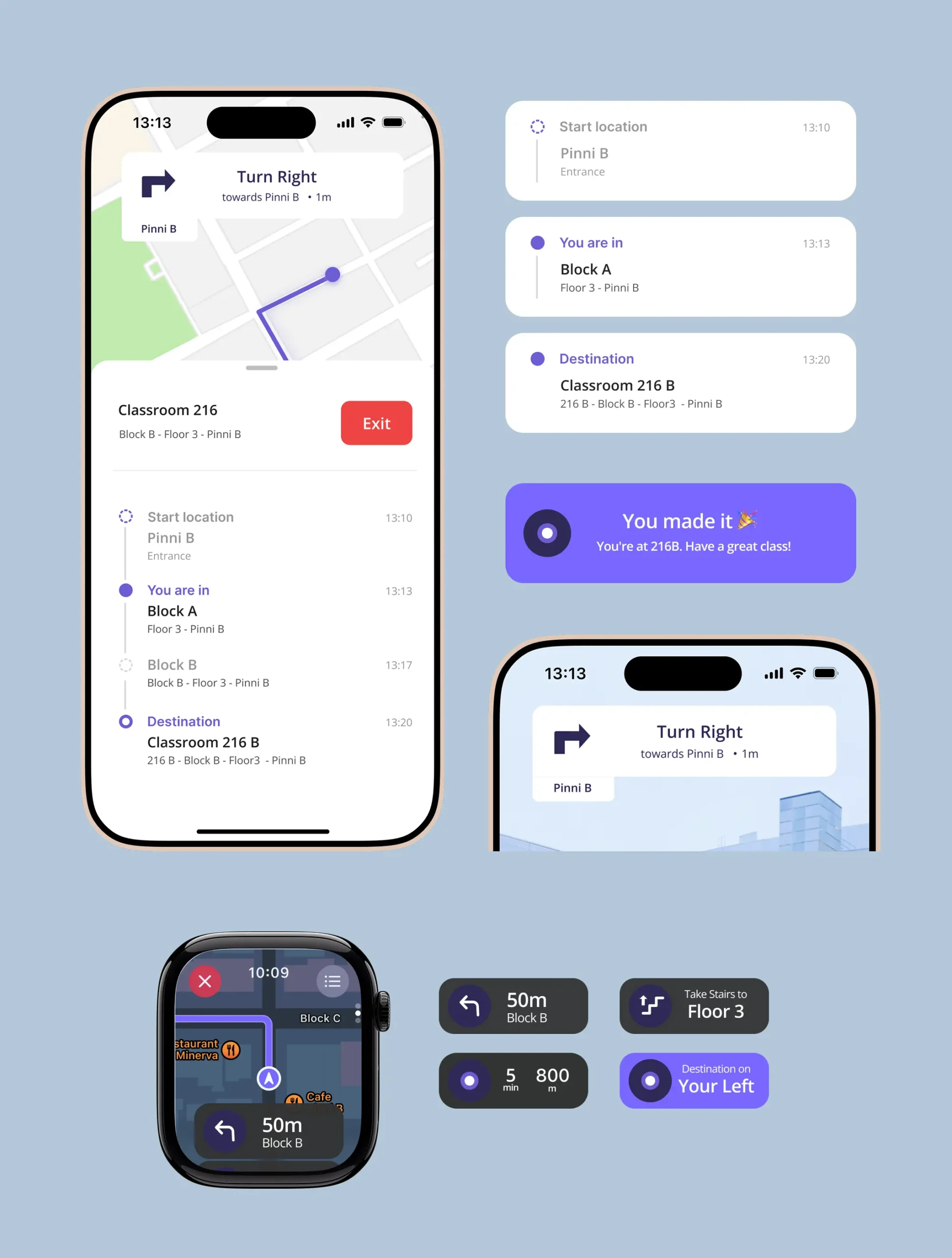
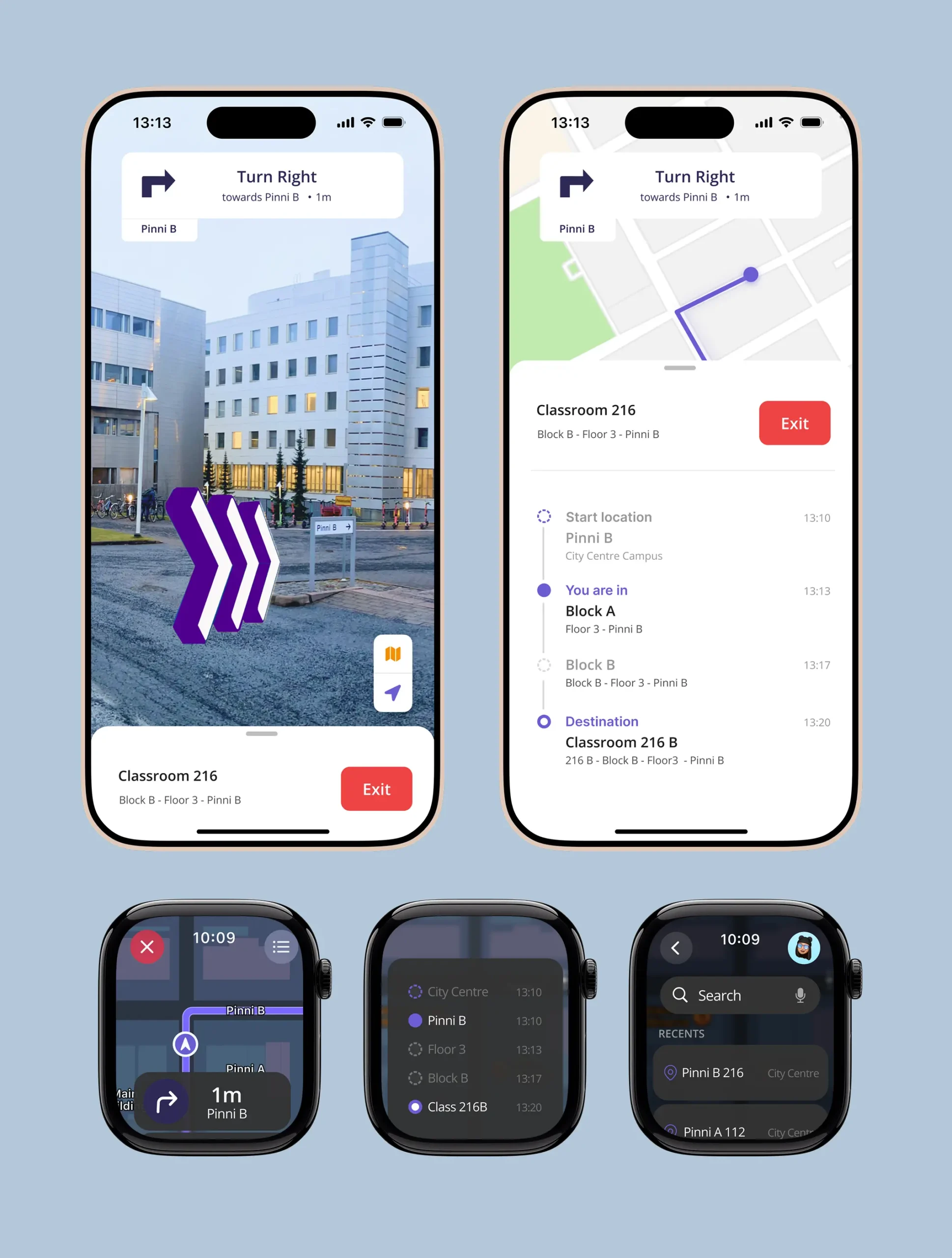
Rather than only displaying routes, the experience continuously reassures users that they are progressing correctly through contextual confirmations, progress indicators, and timely guidance.
Outcome
- Reduced second-guessing
- Increased first-attempt navigation success
- Higher navigation confidence
Context-Aware Guidance
Research showed that hesitation clustered around entrances, intersections, and floor transitions rather than throughout the entire route.
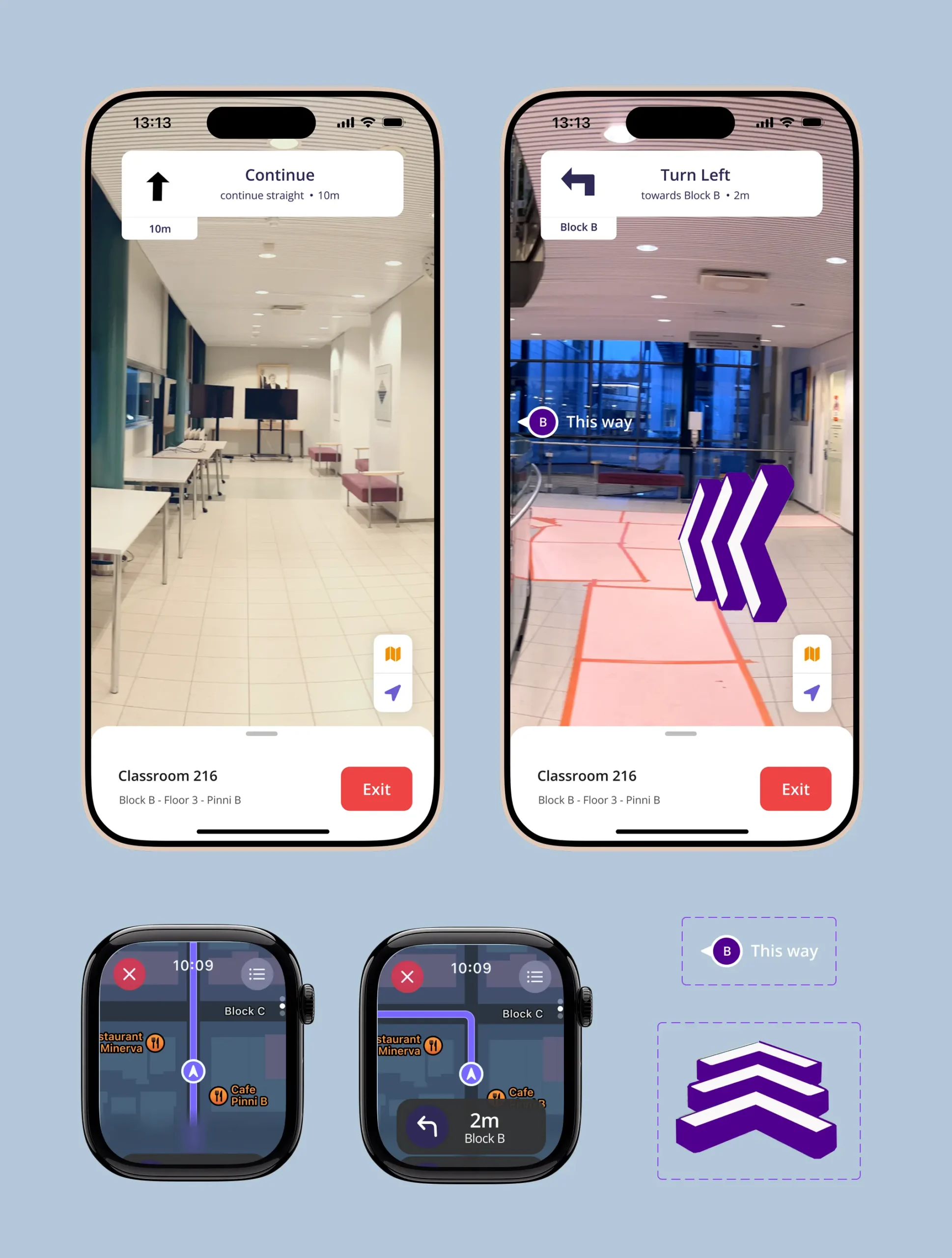
The experience adapts guidance based on the user's context, providing enhanced visual cues at critical decision points while minimizing distraction during straightforward movement.
Outcome
- Reduced hesitation at decision nodes
- Faster directional commitment
- Lower cognitive load
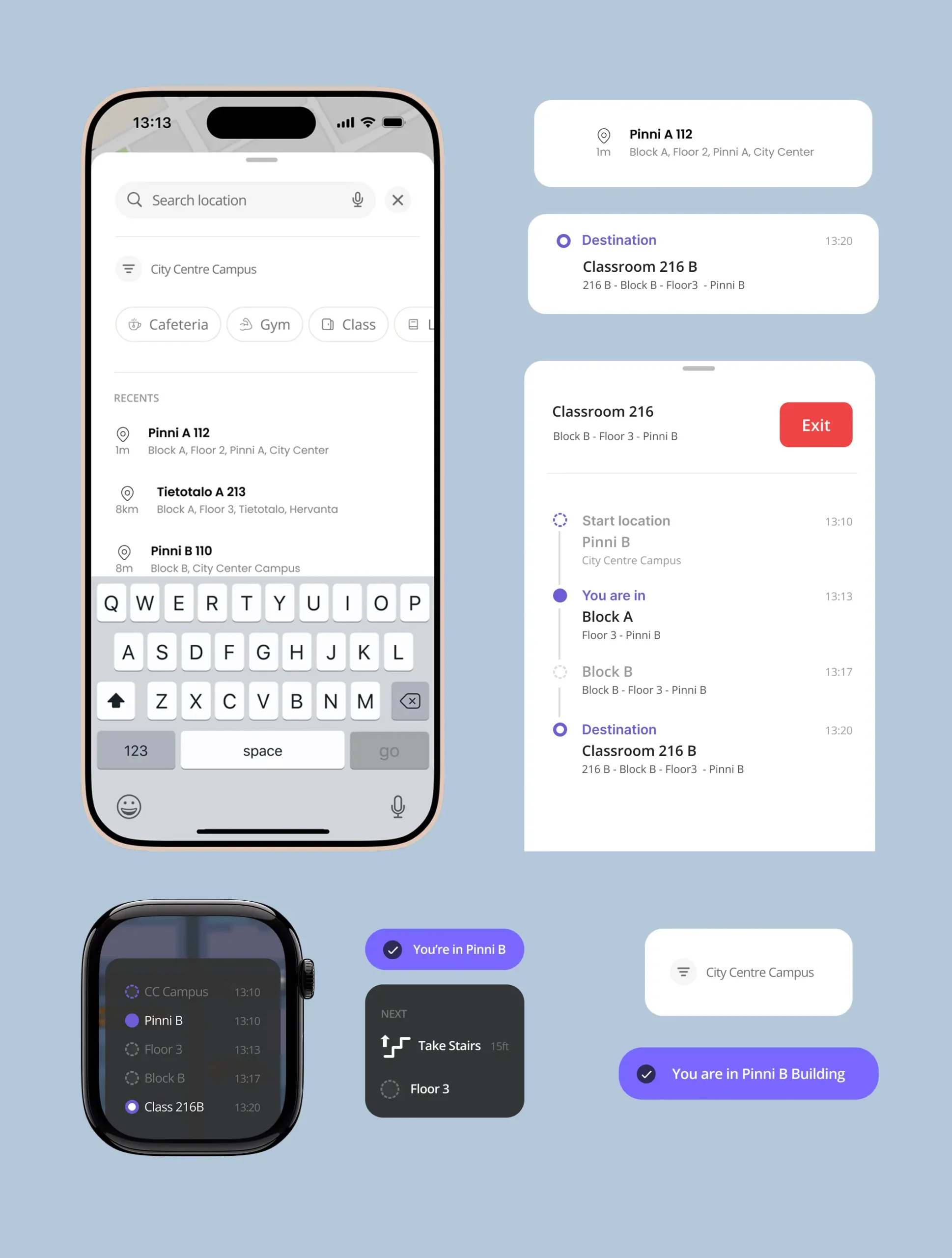
Continuous Spatial Orientation
Students often knew their destination but struggled to understand their position within the broader campus environment.
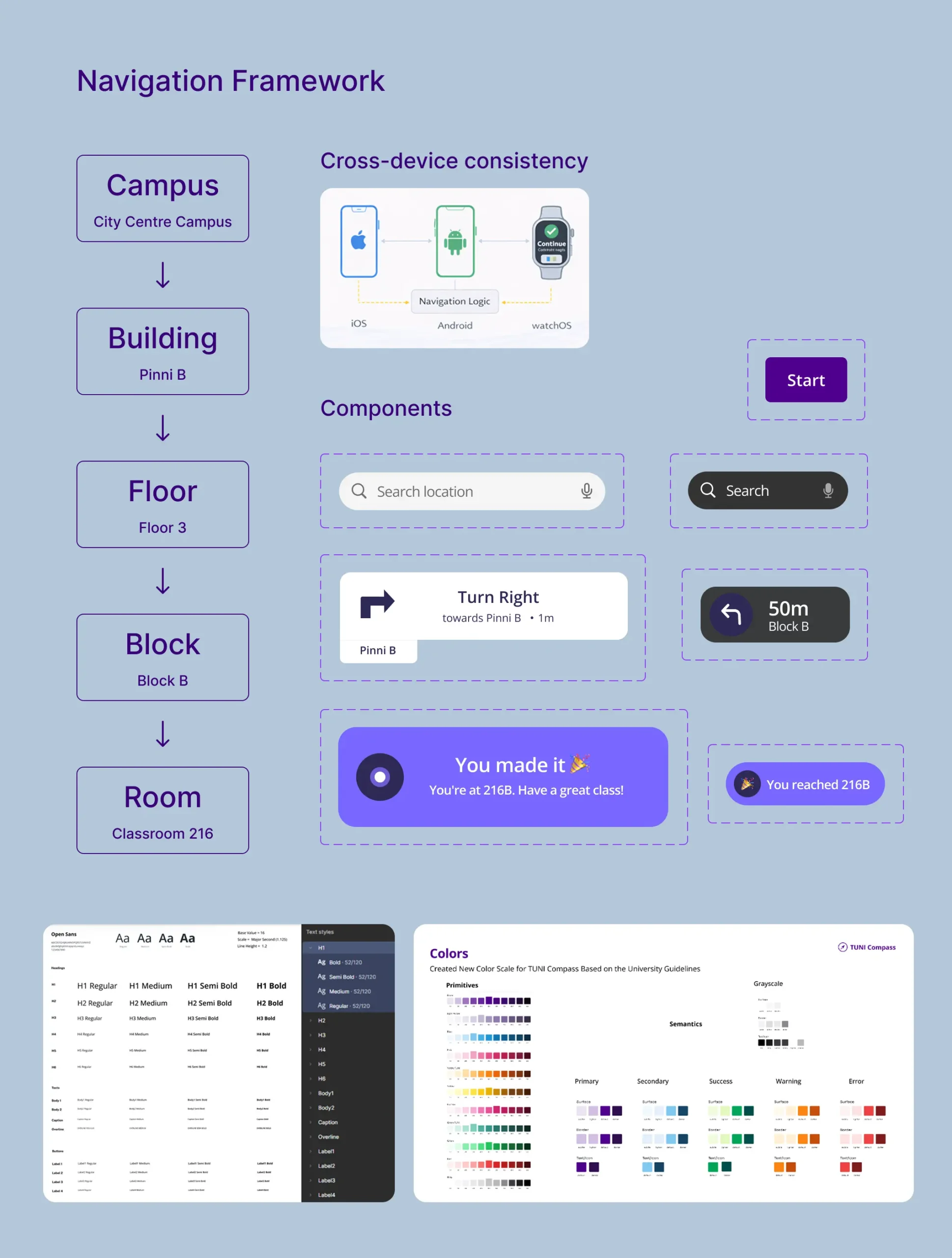
To strengthen spatial awareness, the system continuously reinforces the relationship between campus, building, floor, and room, helping users maintain orientation throughout the journey.
Outcome
- Improved environmental awareness
- Reduced orientation errors
- Stronger mental model of the campus
Cross-Device Navigation
Navigation is inherently mobile and often occurs under time pressure.
To support movement without interruption, TUNI Compass extends seamlessly across mobile and Apple Watch. While the mobile experience supports planning and exploration, watchOS provides glanceable guidance that allows users to stay informed without repeatedly checking their phone.
Outcome
- Reduced interaction during movement
- Seamless navigation continuity
- Improved accessibility while walking
Scalable Navigation Framework
The solution was designed as a navigation system rather than a campus-specific application.
A modular information architecture and reusable design patterns provide a foundation that can scale across campuses, buildings, and future navigation technologies while maintaining a consistent user experience.
Outcome
- Scalable across multiple environments
- Consistent navigation experience
- Future-ready system architecture
✨ Impact
To evaluate whether TUNI Compass successfully addressed the core challenge, we conducted comparative usability testing with 12 participants (8 first-year students and 4 international students).
Participants completed identical navigation tasks across unfamiliar campus locations using existing navigation methods before repeating the same tasks with the TUNI Compass prototype.
Performance was measured through task completion, behavioral observation, and post-task confidence surveys to validate whether the solution reduced uncertainty during real navigation scenarios.
92%
First-Attempt
Navigation Success
-65%
Decision-Point
Hesitation
4.5 / 5
Navigation
Confidence
Navigation Friction Is Episodic, Not Continuous
Measurement
Percentage of participants who reached their assigned destination without backtracking, asking for assistance, or taking an incorrect route.
Results
Before: 58% (7 of 12 participants)
After: 92% (11 of 12 participants)
Impact
Students reached unfamiliar destinations more independently, demonstrating a significant improvement in navigation confidence and route accuracy.
Decision-Point Hesitation
Measurement
Average time participants paused at entrances, corridor intersections, and floor transitions before committing to a direction.
Results
Before: 11.8 seconds
After: 4.1 seconds
Improvement: 65% reduction
Impact
Providing contextual guidance at critical moments enabled users to make faster, more confident navigation decisions while reducing cognitive load.
Navigation Confidence
Measurement
Following each navigation task, participants rated the statement:
“I felt confident that I was following the correct route.”
using a five-point Likert scale.
Results
Before: 2.7 / 5
After: 4.5 / 5
Impact
Participants consistently reported greater confidence throughout the navigation journey, particularly when entering unfamiliar buildings and transitioning between floors.
Overall Impact
The validation confirmed the project's central hypothesis: navigation failures were driven by uncertainty rather than a lack of information.
By designing for confidence instead of simply providing directions, TUNI Compass delivered measurable improvements across all three success metrics.
Project Outcomes
- 92% first-attempt navigation success
- 65% reduction in hesitation at critical decision points
- 67% increase in navigation confidence
- Reduced dependence on external assistance during navigation
- Established a scalable navigation framework for future campus expansion
✨ Reflections
TUNI Compass reinforced that successful products begin with the right problem, not the right solution. What started as a request to build a navigation app evolved into a confidence-centered navigation system through research, problem reframing, and continuous validation.
The biggest takeaway was that users rarely need more information – they need greater confidence in the decisions they’re making. That insight shaped every design decision throughout the project and continues to influence how I approach product design today.
"Great navigation isn't about helping people find a route - it's about helping them trust they're on the right one."